
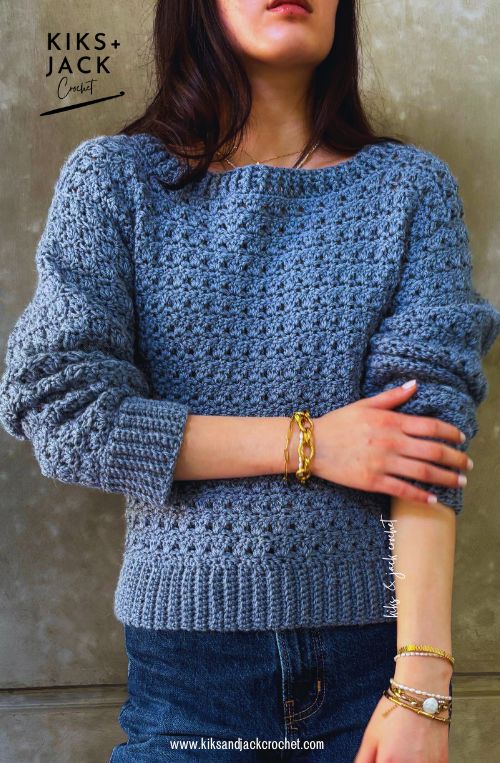
Learn how to crochet the Double Bay Simple Crochet Sweater, a beginner-friendly, timeless sweater that you can wear all year. This free crochet pattern is made-to-measure and size-inclusive, so it fits beautifully as it’s based on your exact measurements. Use the interactive table of contents at the end of this section to follow the step-by-step written instructions. With its classic design and easy-to-follow steps, we love The Double Bay Simple Crochet Sweater Pattern as it’s perfect for layering, gifting, or throwing over as a simple basic.
Please support our work: We are trying to keep all our crochet patterns free for everyone, when you access them online. We meet the costs of running this website through coffee donations at https://ko-fi.com/kiksandjackcrochet and ad revenue. When you buy us a cup of coffee, you buy us a cup of motivation. Thank you for keeping us motivated and inspired every day to keep designing free crochet patterns for you.
It’s been a jam packed year for us. We made a decision half way through the year that we were going to invest some time in creating video tutorials for some of the stitches used in our pattern. Specifically the harder and more popular patterns. Our first video took us sooo long. We must have filmed over 20 times – changing the background, the lighting, filming with sound, filming without sound. We actually felt pretty disheartened at how long it was taking and planned to quit multiple times…but we stuck with it! After hours and hours of filming and editing, we created our first stitch video tutorial.
We are so glad we did as the feedback was awesome and it was incredibly rewarding! We plan to make more videos to complement our written patterns in 2026 – check out our YouTube channel, click here, subscribe to us would help support us. Is there a pattern you would love a stitch video for? Email us to let us know and we will try to bump it up to the top of our list.
So after crazy video filming and editing, and an array of color in sweaters like The Blackberry Easy Fluffy Sweater and the vibrant Esther Easy and Beautiful Flower Crochet Sweater along with the slightly glittery Lacy Holiday Crochet Tie-Up (our 2026 Holiday Sweater), it’s so nice to finish off with something simple and basic and a sweater we know we will reach for on an everyday basis: The Double Bay Simple Crochet Sweater Pattern!
We used a gorgeous yarn that is completely new to us. It’s an alpaca blend and its super warm. We kept the sweater a little tighter (this is considered tight for us ha ha) and a little shorter than our typical oversized pullovers – however you can customize it based on our made to measure patterns.
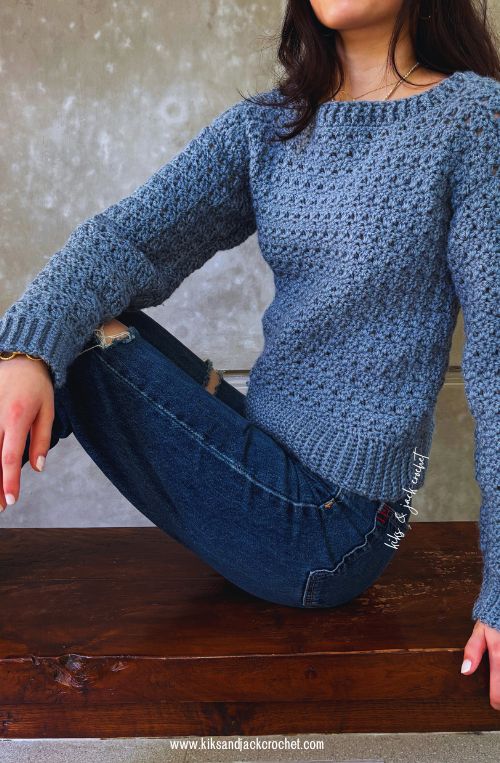
We selected a stitch that gave us beautiful texture but kept it simple, basic and consistent on the sleeves. We love the end result and decided to call it The Double Bay Simple Crochet Sweater Pattern. We love the simplicity of the name, the simplicity of this beautiful bay in Australia, and the simplicity of this gorgeous blue sweater. We really hope you do too!
Lets get you started on The Double Bay Simple Crochet Sweater Pattern!
Please support us by following us on social media. Simply click on the icons below and we will keep you up to date on new free pattern releases. Tag us your version of The Double Bay Simple Crochet Sweater so that we can add your work to our stories and share it with our followers too!
DESCRIPTION of The Double Bay Simple Crochet Sweater
The Double Bay Simple Crochet Sweater is an easy crochet sweater pattern in a beautiful worsted alpaca blend yarn, perfect for layering and wearing all year. You can customize it to your preferred length, shorter and cropped, or longer and relaxed using the made-to-measure, size-inclusive instructions. The sleeves continue the main panel stitch, and the neckline is easy to adjust for a closer fit or a slightly more open style or even off the shoulder, giving you the flexibility to make it your own.
This beginner-friendly, free crochet pattern works up quickly and easily thanks to the simple stitch design. Because it’s made to your exact measurements ie “made to measure”, the gauge is flexible, helping you create a sweater that fits beautifully. The Double Bay Simple Crochet Sweater is a versatile design perfect for layering, gifting, or throwing on over any outfit as a timeless wardrobe staple.
CROCHET MEASUREMENTS & SIZES for The Double Bay Simple Crochet Sweater
The pattern instructions are made to measure, based on your required measurements.
At Kiks + Jack Crochet, we focus on creating made-to-measure, size-inclusive crochet patterns rather than relying on standard commercially graded sizes (XS–5XL). This allows crocheters to enjoy the satisfaction of making a garment that fits beautifully to your perfect dimensions. We also understand that taking measurements isn’t always convenient, so we’ve included standard measurements for anyone who prefers to follow them instead.
To use The Double Bay Simple Crochet Sweater pattern you will need the following measurements and you should write them down for easy reference:
Chest/Bust: Measure around the fullest part of your chest/bust. Do not draw the tape too tightly.
Finished length: Measure from just below the waist (or where you would like the sweater to end) up to the top of your shoulder at your collarbone.
Armhole Depth: Measure from the top outside edge of the shoulder down to the armpit. You may want to check that this measurement – when doubled – is as big as your upper arm circumference (around your bicep). Typically it is, however every body shape is different. If your upper arm circumference is larger, take this measurement instead.
Arm Length: Measure from armpit to wrist (or where you would like the sleeve to end)
Wrist Circumference: Measure from one point on your wrist all around your wrist. Do not draw the tape too tightly.
Standard Measurements (For Reference)
If you would like to use standard sizing for the chest/bust – then for XS (S, M , L, XL, 2XL, 3XL, 4XL, 5XL) use approximately 28-30 (32-34, 36-38, 40-42, 44-46, 48-50, 52-54, 56-58, 60-62) inches or 71-76 (81-86, 91-96, 102-107, 112-117, 122-127, 132-137, 142-147, 152-158) centimetres.
If you would like to use standard sizing for armhole depth – then for XS (S, M , L, XL, 2XL, 3XL, 4XL, 5XL) use approximately 6-6.5 (6.5-7, 7-7.5, 7.5-8, 8-8.5, 8.5-9, 9-9.5, 9.5-10, 10-10.5) inches or 15.5-16.5 (16.5-17.5, 17.5-19, 19-20.5, 20.5-21.5, 21.5-23, 23-24, 24-25.5, 25.5-26.5) centimetres
If you would like to use standard sizing for arm length – then for XS (S, M , L, XL, 2XL, 3XL, 4XL, 5XL) use approximately 16.5 (17, 17, 17.5, 17.5, 18, 18, 18.5, 18.5) inches or 42 (43, 43, 44.5, 44.5, 45.5, 45.5, 47, 47) centimetres
Note: The Double Bay Simple Crochet Sweater is designed as an oversized fit with positive ease.
CROCHET GAUGE
The Double Bay Simple Crochet Sweater is made to measure and can accommodate for different crochet gauges. You do not need to swatch and match to our gauge however we suggest for this pattern you use a yarn and hook of similar weight and size.
For our version of The Double Bay Simple Crochet Sweater we used a weight 4 yarn and a 5.5 mm hook.
CROCHET MATERIALS for The Double Bay Simple Crochet Sweater
This section contains product affiliate links. We may receive a small commission (at no extra cost to you) if you make a purchase after clicking on one of these links.
Kiks + Jack Crochet promises to only recommend products that we love and that we use. Thank you for supporting us.
Yarn Brand: Touch of Alpaca by Lion Brand Yarns. Weight 4/Worsted 100g per skein and 207 yards (or 190 m). We used the colour Dusty Blue.
Kiks + Jack Crochet’s version of The Double Bay Simple Crochet Sweater has a finished width of approximately 16.5 inches and a finished length of 20 inches. We used approximately 4.9 skeins in total, or 1014 yards (or 931 m).
Other yarns we would love to try out for The Double Bay Simple Crochet Sweater include:
Acacia by Hobbii Yarns
Heathered Tweed by Loops and Threads (Michaels)
Crochet Hook (we used a 5.5 mm). We use many different crochet hooks and if you are looking for some great budget friendly ergonomic crochet hooks try these from Amazon. It comes in a set and the grip and the shape is amazing for beginner crocheters. We also love the slightly more pricey crochet hooks from Clover Crochet Hooks and the beautiful Furls Crochet Hooks (these are so stunning, we just love looking at them!)
Yarn Winder!!! (Our new LOVE). We had held off on a yarn winder for a long time. We love the idea of crochet being simple with just a hook and some yarn. However we decided to get this yarn winder, because it was affordable and we weren’t sure about investing in a super fancy one yet. We love it because it breathes life back into scrappy yarn lying around that looks messy. It’s simple to use and is holding up really well for us.
Measuring Tape. We use a super budget friendly measuring tape. Make sure it has cm and inches (not all patterns are written with both). We are always crocheting on the go so we like our tapes small and compact and we put one in our design area, one in our bag and one in our car. Retractable works best! We use these super cheap mini measuring tapes from Amazon
Stitch Markers. We use these locking crochet stitch markers from Amazon and these stitch markers that do not lock. They are cheap and colourful.
Blocking Pins. You should buy more pins than you think you need. If you are going to take the time to block don’t skimp on the pins. We like T shaped stainless steel pins that don’t rust when they get wet. We love these blocking T pins from Amazon and the tin means the pins don’t fall out on the floor.
Yarn Needle. Buy blunt needles with large eyes for yarn. We use these Yarn Needles because we like the convenient bottle, they are budget friendly and we get lots of them!
Scissors. We love these thread snippers because they are cheap, we get two of them AND they come with a case (some don’t). Don’t carry these without the case! After you use thread snippers you won’t want to snip with scissors.
CROCHET STITCHES & ABBREVIATIONS
The Double Bay Simple Crochet Sweater pattern is written with US terms.
ch = chain (With one loop on your hook, yarn over and pull through the loop)
sc = single crochet (Insert hook into desired stitch. Yarn over and pull through the stitch. You now have two loops on your hook. Yarn over and pull through all two loops)
hdc = half double crochet (Yarn over and insert hook into desired stitch. Yarn over and pull through the stitch. You now have three loops on your hook. Yarn over and pull through all three loops)
dc = double crochet (Yarn over and insert hook into desired stitch. Yarn over and pull through the stitch. You now have three loops on your hook. Yarn over and pull through the first two loops. You now have two loops on your hook. Yarn over and pull through all two loops)
ch-2 sp = chain 2 space (You are crocheting into the space created by the chain 2 from the previous row and not the stitch)
BLO = back loop only
sl st = slip stitch (Insert hook into desired stitch. Yarn over and pull through the stitch. Pull through the stitch and the loop on your hook)
fpdc = front post double crochet (Yarn over and insert your hook from the front side to the back side of your work around the double crochet – the post – from the previous row, coming up on the opposite side of the stitch. Yarn over and pull up a loop. You will now have three loops on your hook. Yarn over and pull through the first two loops. You will now have have two loops on your hook. Yarn over and pull through all two loops)
bpdc = back post double crochet (Yarn over and insert your hook from the back side to the front side of your work around the double crochet – the post – from the previous row, coming up on the opposite side of the stitch. Yarn over and pull up a loop. You will now have three loops on your hook. Yarn over and pull through the first two loops. You will now have have two loops on your hook. Yarn over and pull through all two loops)
tch = turning chain
st = stitch
sk = skip stitch
* = repeat the instructions following the * as directed
Note unless stated otherwise turning chains do not count as a stitch if there are 1 or 2 chains and the turning chain does count as a stitch if there are 3 or 4 chains.
SUMMARY of CONSTRUCTION for The Double Bay Simple Crochet Sweater
The Double Bay Simple Crochet Sweater is constructed by first making the back and front panels separately. You’ll start with the ribbing along the bottom edge, then work each panel upward to the shoulders. Once the panels are complete, you’ll shape the neckline openings on both the front and back.
After the body panels are finished, you’ll move on to the sleeves, beginning with the sleeve ribbing and then working the main sleeve panels. The sweater comes together by joining the shoulders and attaching the sleeves directly to the body. Finally, the ribbed neckline is added, to give a cozy finish that sits comfortably around the neck.
PERMISSIONS AND COPYRIGHT
You may not publish or share any pattern on this website www.kiksandjackcrochet as your own including this pattern The Double Bay Simple Crochet Sweater. Except as permitted by the copyright law applicable to you, you may not reproduce or communicate any of the content on this website, including files downloadable from this website, without the permission of the copyright owner, Kiks + Jack Crochet.
You may not use any Kiks and Jack Crochet photo as your own photo.
You may crochet items to sell using The Double Bay Simple Crochet Sweater pattern upon permission by email at [email protected]. Please link back to this post in exchange.
Crochet Pattern Instructions for The Double Bay Simple Crochet Sweater
Crochet the Back Panel Ribbing
🎥 Watch: How to Crochet Single Crochet Ribbing
Need some help with your single crochet ribbing? Learn how to crochet the perfect single crochet ribbing for sweaters, cardigans, and cuffs in this quick 9-minute tutorial. This beginner-friendly video shows you our “made to measure” method, how to keep your ribbing neat and even, and exactly where to start your sweater once the ribbing is complete. Follow along step by step for visual learners, or if you prefer to move straight to the written instructions, find them below.
The written pattern and step-by-step instructions are below.
ch 12
The height of our ribbing is approximately 3 inches. Based on our gauge this is 12 chains. However you can adjust the number of chains if you want to change the height of the ribbing.
Row 1: sc in 2nd ch from hook, sc in each ch across until end. Turn
Row 2: ch1, sc BLO in each st across. On the last st, sc into the entire st. Turn
Repeat row 2 until the total length of the ribbing is equal to HALF of your “Chest/Bust Measurement” + 1-2 inches (depending on how fitted you would like your sweater)
K+J example: Our chest/bust measurement = 16 inches around. Half of 32 inches = 16 inches. We keep repeating row 2 until the total length of the ribbing reaches 17 inches (16 + 1 = 17 inches)
Count the total number of rows.
K+J example: We counted a total of 66 rows to achieve a length of 17 inches.
It’s a great time to conduct an intuitive check if you are completely happy with the width of the sweater before you crochet any further. Place the ribbing up against you to see if the width (length of ribbing) is right for you. If you would like it to be wider, crochet a few more rows. If you would like the ribbing to be tighter, then you can frog (unravel) a few rows.
Do not fasten off.
Crochet the Back Panel
You will now crochet down the long side of the ribbing that you just crocheted.
To calculate the number of stitches that you will crochet down the long side of the ribbing, calculate as follows:
| Calculation | Kiks + Jack Crochet Example |
| Count the number of rows in your ribbing | We have 66 rows in our ribbing (to achieve 17 inches) |
| If this number is NOT a multiple of 3 then increase it until it is a multiple of 3 (divides into 3 evenly). If this number is already a multiple of 3, then leave it as is. | 66 is a multiple of 3 so we keep it as is. |
Row 1: Using the working yarn, ch1, sc into the first st, sc across the ribbing the number of stitches you calculated above. Turn
In K+J example above we will crochet 66 single crochets evenly across the long side ribbing. We used stitch markers to divide the ribbing into 4 equal sections and it helped us crochet a little more evenly.
Row 2: ch2, [1sc, ch2, 1sc] all into the 1st st, *sk next 2 st, [1sc, ch2, 1sc] in next st, rep from * across, when you get to the last two st, sk 1st, end with 1 hdc in last ch. Turn.
Row 3: ch3, *3dc in next ch-2 sp, rep from * across, ending with 1dc in top of tch. Turn
Row 4: ch2, *[1sc, ch2, 1sc] all in the 2nd dc of the 3dc cluster made in the previous row, rep from * across, ending with 1hdc in top of tch. Turn
Repeat rows 3-4 in that order until the back panel (including ribbing) is equal to your “Finished Length Measurement minus 2-3 inches (depending on how deep you would like your neckline)”. Make sure you end on a row 3.
K+J example: Our “Finished Length Measurement” is 20 inches. Therefore we crochet rows 3-4 in that order until the total back panel including the ribbing equals 18 inches (we want an approximately 2 inch neckline depth). We make sure to finish on a row 3.
Fasten off.
Crochet the Front Panel
Repeat all the instructions under Back Panel Ribbing and Back Panel so that you have an identical front panel.
Measure the Neckline on the Back and Front Panel
We will now measure out the neckline for the sweater.
Measure approximately 4-5 inches in from the left edge of the back panel and place a stitch marker after the cluster (we will be adjusting the exact inches that is right for you shortly). This will be the start of your neck opening.
Count the number of clusters from the left edge up to the stitch marker. Count the same number of clusters on the right side of the back panel and place a stitch marker. Do the same on the front panel on both sides.
Attach the two panels together lining up the 4 stitch markers and secure the panels together with locking stitch markers. Place the panels over your head and double check you are happy with the neck opening.
If you would like it tighter then move the stitch markers closer to your neck ensuring you place the stitch marker at the end of a cluster not in the middle of a cluster. If you would like the neck opening wider, then move the stitch markers away from your neck. Make sure it is the same distance (ie. same number of clusters) on either side and on the front and back panel. Note: you will be crocheting a ribbing that is approximately 1 inch wide.
Kiks + Jack Crochet measured in 4.5 inches from each side. This gave us a comfortable but slightly wider neck opening.
Crochet the Neckline on the Back and Front Panel
Once you are satisfied with the neckline measurements, we will start to crochet it. Start with the back panel and attach the yarn to the first stitch near the left shoulder. You are crocheting from the edge to the first stitch marker (not stitch marker to stitch marker) and you should have just finished a Row 3.
Row A: ch2, *[1sc, ch2, 1sc] all in the 2nd dc of the 3dc cluster made in the previous row, rep from * across, ending with 1hdc where you placed the SM. Turn
Row B: ch3, *3dc in next ch-2 sp, rep from * across, ending with 1dc in top of tch. Turn
Row C: ch2, *[1sc, ch2, 1sc] all in the 2nd dc of the 3dc cluster made in the previous row, rep from * across, ending with 1hdc in top of tch. Turn
Repeat row B-C in that order until the total back panel (ribbing + main back panel + neckline) is equal to your “Finished Length Measurement”. We like to place it up against us an additional check to make sure that everything looks good.
Repeat on the other side of the back panel and on both sides of the front panel.
Fasten off.
Crochet the Sleeve Panel Ribbing (Make 2)
We will now start to crochet the two sleeve panels starting with the ribbing. Remember you will need to make two identical sleeve panels.
ch 12
Row 1: sc in 2nd ch from hook, sc in each ch across until end. Turn
Row 2: ch1, sc BLO in each st across, on the last st sc into the entire stitch. Turn
Repeat row 2 until the ribbed cuff is equal to your “Wrist Circumference Measurement” + 2 inches. Make sure it fits comfortably and is not too tight.
Count the number of rows (we crocheted 38 rows).
Do not fasten off. Turn your ribbing.
Crochet the Sleeve Panel (Make 2)
You will now crochet down the long side of the ribbing that you just crocheted.
To calculate the number of stitches that you will crochet down the long side of the ribbing, calculate as follows:
| Calculation | Kiks + Jack Crochet Example |
| Count the number of rows in your ribbing | We have 38 rows in our ribbing |
| If this number is NOT a multiple of 3 then increase it until it is a multiple of 3 (divides into 3 evenly). If this number is already a multiple of 3, then leave it as is. | 38 is not a multiple of 3 so we increase to 39 single crochets |
Row 1: Using the working yarn, ch1, sc into the first st, sc across the ribbing the number of stitches you calculated above. Turn
In K+J example above we will crochet 39 single crochets evenly across the long side ribbing.
Row 2: ch2, [1sc, ch2, 1sc] all into the 1st st, *sk next 2 st, [1sc, ch2, 1sc] in next st, rep from * across, when you get to the last two st, sk 1st, end with 1 hdc in last ch. Turn.
Row 3: ch3, *3dc in next ch-2 sp, rep from * across, ending with 1dc in top of tch. Turn
Row 4: ch2, *[1sc, ch2, 1sc] all in the 2nd dc of the 3dc cluster made in the previous row, rep from * across, ending with 1hdc in top of tch. Turn
Repeat rows 3-4 in that order until the length of the sleeve panel (including ribbing) is equal to approximately 1/3 up your forearm. End on a row 3.
At this point, measure the width of your sleeve panel. You need this width to eventually be [2 x your Armhole Depth Measurement + 1.5 inches]. For example our armhole depth measurement is approximately 6.5 inches. So we need the width of our sleeve panel to be approximately 14.5 inches wide.
We will now use expanding rows until the sleeve panel is wide enough based on your dimensions.
Expanding Row A: ch1, [1sc, ch2, 1sc] all in the 1st st, *[1sc, ch2, 1sc] all in the 2nd dc of the 3dc cluster made in the previous row, rep from * across, ending with [1sc, ch2, 1sc] in top of tch. Turn
Row B: ch3, *3dc in next ch-2 sp, rep from * across, ending with 1dc in top of tch. Turn
Don’t forget in Row B to include those two extra clusters you made in Row A at the start and end of the row. You will block these out later to smooth out the increase.
Row C: ch2, *[1sc, ch2, 1sc] all in the 2nd dc of the 3dc cluster made in the previous row, rep from * across, ending with 1hdc in top of tch. Turn
Repeat Rows B-C in that order, two more times.
Repeat one more Row B.
At this point, take another measurement. If you still need to expand, then repeat this process again ie. start with Expanding Row A, crochet rows B-C a total of three times, finish with another row B.
When your sleeve is wide enough, stop crocheting Expanding Row A and just continue crocheting Rows B-C until the length of the sleeve panel including the cuff, is equal to your “Arm Length Measurement”
Fasten off.
Remember you need to crochet two identical sleeve panels.
Assembling The Double Bay Simple Crochet Sweater
Kiks + Jack Crochet highly recommends blocking all your panels before assembly. Blocking your panels will set your panels to the shape and size you want and give it a polished look. It is important to specifically use pins on the Expanding Rows A on the sleeve to smooth out the increases.
We block our panels by pinning all the pieces on to an old yoga mat and manipulating the shape and edges so the front and back panel are similar and the two sleeve panels are similar. We then spray it with water focusing on the edges and ensuring it is well saturated. Do not remove the pins until the panels are completely dry.
Step 1: Seam the Front and Back Panel at the shoulder.
Place the front and back panels together with the right sides facing together. With a yarn needle, seam the two panels together across the shoulders starting from the edge and across. Fasten off.
Step 2: Line up your sleeves at the midway point to the shoulder and seam.
Open up the two panels (now seamed at the shoulders) so that the right side is facing the floor and the wrong side is facing upwards. Take one of your crocheted sleeves and fold it in half lengthways. Place a locking stitch marker at the top of your sleeve at the centre point. With the wrong side of the sleeve facing up, attach this stitch marker to the left edge of the left shoulder seam.
Customization Tip: It is a good time to check the length of your sleeve. You can “seam” it with a few locking stitch markers to the main panel. Try it on. If you would like the sleeve to be longer, you can remove the knot on your sleeve panel (where you fastened off) then add a few more rows on to your sleeve. Or you can reduce rows if you like your sleeves shorter by removing the knot first and pulling out (frogging) a few rows. Make sure you do the same on the second sleeve so they are identical.
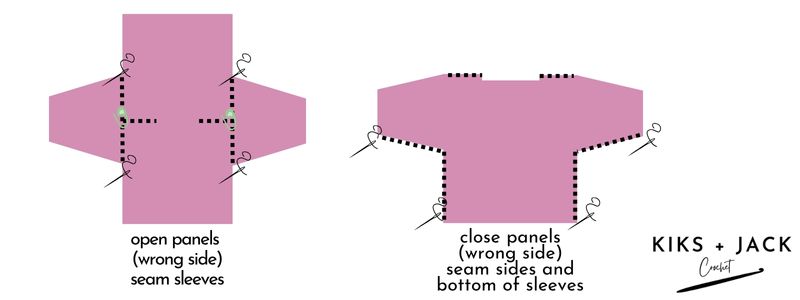
When everything is perfect, using a yarn needle and matching yarn, seam the sleeves to the main panels (wrong side facing up) – see first diagram below (illustrative purposes only).
Do the same on the right side with the other sleeve.
Step 3: Seam the sides of the sweater and the bottom of the sleeve together.
Fold the two panels and sleeve panels at the seamed shoulders so that your sweater is facing wrong side out. With a yarn needle and matching yarn, seam the sides of the two panels together up to the armpit and along the bottom of the sleeve (see second diagram below).
Diagram for illustrative purposes only – not to scale or completeness.
Fasten off.
Step 4: Add the ribbing to the neckline
Turn the sweater right side out. Attach a yarn to the side of the neckline.
Round 1: ch1, sc in the first st, sc evenly around the neckline into every st. When you complete the round, sl st to join at the top of the tch.
Round 2: ch3, dc in 2nd st, dc around into every st, when you complete the round, sl st to join at the top of the tch
Round 3: ch3, *fpdc, bpdc, rep from * until end of the round, sl st to the first fpdc. Go back up to the section Crochet Stitches & Abbreviations for instructions on how to crochet Front Post Double Crochet (fpdc) and Back Post Double Crochet (bpdc).
Round 4: repeat row 3 (or you can leave row 4 out if you want a thinner ribbing around the neck).
Fasten off.
Finish & Celebrate The Double Bay Simple Crochet Sweaterr
Weave in all your ends.
Congratulations you have finished The Double Bay Simple Crochet Sweater and we hope you enjoyed this free crochet pattern.
Please support our work: We are trying to keep all our crochet patterns free for this amazing crocheting community, when you access them online. We meet the costs of running this website through coffee donations at https://ko-fi.com/kiksandjackcrochet and ad revenue. When you buy us a cup of coffee, you buy us a cup of motivation. Thank you for keeping us motivated and inspired every day to keep designing free crochet patterns for you.
It would be amazing to see a photo of your completed work on instagram. Tag your version of The Double Bay Simple Crochet Sweater @kiksandjackcrochet and please follow us on social media. It really helps support our work.